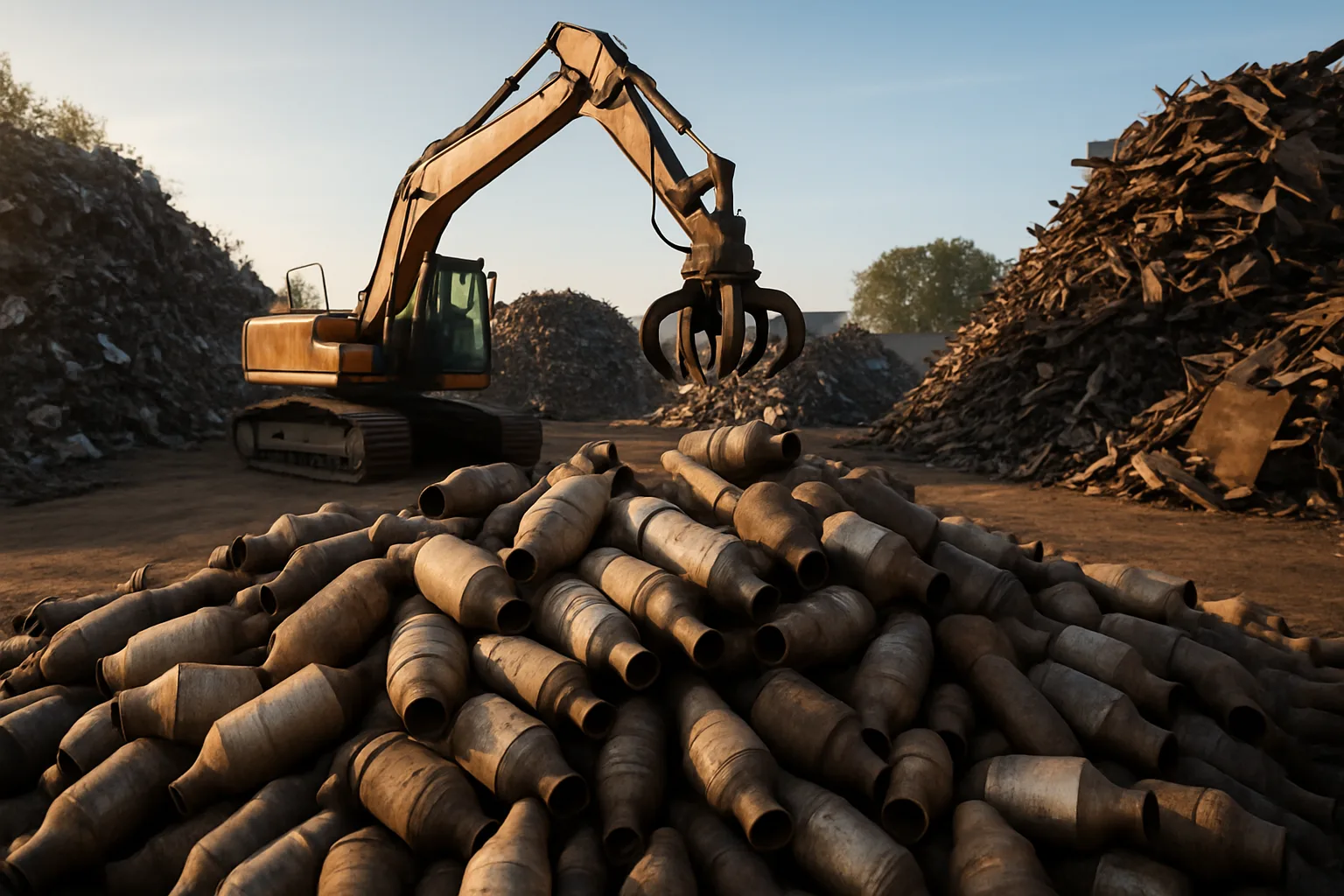
Catalytic Converter Recycling: What's Inside, What It's Worth, and Why Prices Keep Changing
Most people know catalytic converters are valuable. Fewer people understand why — and that gap costs recyclers money every single time they sell one. If you're sitting on a pile of cats in Kansas City and you're taking whatever your single buyer offers, you're leaving real money on the table. This week's market recap breaks down how catalytic converter recycling actually works, what drives price swings, and how to stop guessing when you sell.
And yes — we'll touch on the copper scrap price today connection, because it matters more than most people realize when you're trying to read the broader metals market.
What's Actually Inside a Catalytic Converter
The value isn't in the steel shell. It's in the honeycomb substrate inside — a ceramic or metallic matrix coated with platinum group metals (PGMs): platinum, palladium, and rhodium. These three metals do the actual emissions conversion work, and they trade on global commodity markets just like copper or aluminum.
Here's what makes cats different from most scrap: the PGM content varies dramatically by vehicle make, model, year, and engine type. A domestic pickup truck cat and a foreign luxury vehicle cat can look nearly identical on the outside and be worth completely different amounts. A small domestic cat might yield trace PGMs. A large foreign cat from a higher-emission engine could contain significantly more palladium and rhodium. That spread is not trivial — it can mean the difference between a load worth hundreds of dollars and one worth several times that.
- Platinum: Used in diesel catalytic converters primarily. Prices fluctuate with industrial demand and mining output from South Africa.
- Palladium: Dominant in gasoline engine converters. Highly volatile — prone to significant swings tied to automotive production cycles.
- Rhodium: The rarest of the three. Historically the most price-volatile PGM, with dramatic peaks and troughs over short periods.
When recyclers talk about "assay value," they're talking about what a smelter or refiner discovers when they actually process the material and measure PGM recovery. That number determines final payout — not the guesswork estimate from a single buyer on the phone.
How the Recycling Process Actually Works
Understanding the steps helps you understand where value gets captured — and where it leaks out if you're not careful.
Step 1 — Collection and ID: Cats get pulled from end-of-life vehicles, sorted, and identified. Serial numbers, OEM stamps, and physical characteristics help identify the converter type. Platforms with built-in VIN lookup and serial tracking make this faster and more accurate. Sloppy ID at this stage means inaccurate pricing downstream.
Step 2 — Decanning (optional): Some processors remove the steel shell to reduce shipping weight and expose the substrate. Others ship whole. The choice depends on your buyer's preference and your freight economics.
Step 3 — Sampling and Assay: The processor or refiner samples the substrate, often blending large lots to get a representative sample. Results come back as grams per unit of each PGM. This is where the real number lives.
Step 4 — Settlement: Payment is calculated based on PGM spot prices at settlement date, minus refining fees and the processor's margin. Settlement terms vary — this is a key negotiating point that many sellers never push on.
The takeaway: every step between you and final assay is a point where someone else captures margin. The more transparent your buyer's process, the better your outcome. Documented inventory — photos, serial tracking, accurate unit counts — gives buyers more confidence and gives you leverage.
Why Catalytic Converter Prices Vary So Wildly — And What's Moving the Market in 2026
If you've tried to price a load of cats lately and gotten three different numbers from three different sources, you're not doing it wrong. The market is genuinely complex. Here's what drives the variance.
PGM spot prices: Palladium and rhodium in particular have seen significant volatility over the past several years. Supply disruptions, shifts in EV adoption rates affecting gasoline engine production, and speculative trading all move these markets. When palladium spikes, the cats that are heaviest in palladium get a disproportionate bump. When rhodium pulls back, the high-rhodium units lose value fast.
EV adoption pressure: As battery electric vehicles make up a larger share of new vehicle sales in 2026, the long-term demand outlook for PGMs in automotive applications is under pressure. That doesn't mean today's cats are worthless — far from it — but forward-looking buyers factor this in when setting margins and settlement terms.
Refiner capacity and competition: The number of buyers actively bidding on your material directly affects what you receive. One buyer gives you one price. Multiple vetted buyers competing for your load gives you price discovery. More buyers means better price discovery — that's not a slogan, it's basic economics.
Material quality and documentation: A well-documented lot — clean photos, accurate unit counts, serial numbers matched to known converter types — sells at a different price than a mystery pallet with no records. Buyers price in uncertainty. Remove the uncertainty and the price reflects it.
For Kansas City yards and recyclers across Missouri, this matters practically. The Midwest has strong automotive recycling infrastructure, but many smaller yards still rely on a single regional buyer or broker. That's a one-sided negotiation, and it rarely ends in the seller's favor. To find the best scrap metal prices today, you need competition — not a single phone call to a buyer who already knows you don't have options.
The Copper Scrap Price Today Connection — Reading the Broader Market
Catalytic converters aren't copper plays — but tracking the copper scrap price today tells you something important about overall industrial demand and recycling market health. When copper moves up sharply, it typically signals broad industrial activity: construction, manufacturing, infrastructure spending. Those same demand drivers often support stronger non-ferrous markets across the board.
In 2026, copper pricing has remained a closely watched indicator as infrastructure projects and energy transition investments continue to drive consumption. Yards focused on cats should still track copper, aluminum, and steel benchmarks — not because those metals are in your converters, but because they tell you whether the overall scrap market is in an expansionary or contracting phase. That context shapes how aggressively buyers are bidding.
To check current scrap metal prices across all categories — copper, aluminum, steel, and specialty metals — bookmark a reliable pricing source and check it before every major sale decision. Market conditions in scrap move faster than most sellers track.
For deeper context on how different metals interact in the recycling market, read scrap metal pricing guides that break down what's actually moving prices week to week.
How to Get Better Prices on Your Catalytic Converter Loads — Practical Steps
The process improvements that deliver better prices aren't complicated. They require discipline, documentation, and access to real competition.
- Identify before you sell. Know what you have. Serial numbers, OEM markings, and vehicle source all affect value. Selling unidentified mixed lots consistently gets you the lowest common denominator price.
- Document everything. Photos of each unit. Accurate counts. Condition notes. A clean packing list builds buyer confidence and reduces the uncertainty discount built into their offer.
- Understand settlement terms before you agree. Daily price vs. weekly average? Assay-based or per-unit? Refining fees? These terms have a real dollar impact. Ask before you commit.
- Get multiple bids. This is the single highest-impact change most small and mid-size yards can make. Competition between buyers is the most reliable mechanism for price discovery in any commodity market.
- Time your sales when possible. Not always feasible, but when PGM markets are trending up, holding a load a few days can matter. When markets are pulling back, moving material faster limits your downside.
Platforms like SMASH are built specifically for this. Sell your scrap metal on the SMASH marketplace and put your loads in front of vetted buyers who compete for your material — instead of taking the first number a single buyer gives you. For Kansas City scrap metal services, SMASH connects local yards with a broader buyer network that single-market relationships simply can't match.
SMASH also handles the documentation side — inventory tools, serial tracking, photo documentation, and auto-invoicing — so your lots go to market with the information buyers need to bid confidently. No subscription fees. The model only works when sellers win.
Weekly Market Recap: What Kansas City Recyclers Should Watch This Week
As of this week in July 2026, the broader scrap and PGM markets are being shaped by a few key factors worth monitoring if you're moving catalytic converter material out of Missouri or anywhere in the Midwest.
Palladium has seen some stabilization after a volatile stretch earlier in 2026, but supply-side dynamics from major mining regions remain unpredictable. Rhodium continues to trade at levels that make high-rhodium foreign converters among the most valuable material in the recycling stream — but pricing can shift quickly on thin volume. Platinum demand from industrial applications outside automotive has provided some support, partially offsetting EV-related headwinds on the auto side.
For Kansas City yards specifically: summer vehicle turnover — end-of-life cars coming through auctions and from private sellers — typically increases cat inventory at regional yards through Q3. That's both an opportunity to accumulate material and a reason to have your selling process dialed in before the volume peaks. Entering a high-volume period without a competitive selling process means processing more material for the same margin compression you had before.
The old way — one buyer, one call, one price — doesn't scale with your volume. And it doesn't get better just because you're selling more.
If you're serious about getting better prices on cats and every other material running through your yard, start with better information and better access to buyers. Get the best scrap metal prices — check rates and market data at best-scrap-metal-prices.com and stop leaving money on the table one load at a time.
Disclaimer: Scrap metal and PGM prices fluctuate daily based on commodity markets, regional demand, and material quality. Always verify current rates before making selling decisions. Nothing in this article constitutes a price guarantee or financial advice.
Frequently Asked Questions
Q: How is the copper scrap price today related to catalytic converter values?
Copper prices and catalytic converter values are driven by different metals, but both respond to the same broader signals: industrial demand, global manufacturing activity, and commodity market sentiment. Tracking the copper scrap price today gives recyclers a quick read on whether the overall scrap market is strong or contracting — useful context when timing larger material sales, including cats.
Q: Why do catalytic converter prices vary so much between buyers in Kansas City?
Different buyers have different refining relationships, margin structures, and settlement terms. A buyer offering a flat per-unit rate is pricing in uncertainty — they don't know exactly what your material will yield until it's processed. A buyer offering assay-based settlement is sharing the actual recovery value with you. In Kansas City and across Missouri, getting multiple bids is the most reliable way to understand what your material is actually worth in the current market.
Q: What information should I have ready before selling a load of catalytic converters?
At minimum: unit count, serial numbers or OEM markings where visible, vehicle source if known (domestic vs. foreign, diesel vs. gasoline), and clear photos of each unit. The more accurately you can identify your material, the less uncertainty discount buyers build into their offers. Platforms like SMASH have inventory tools that make this documentation process straightforward and systematic.
Q: How do I find scrap metal pickup near me free in the Kansas City area?
Free pickup availability depends on material volume and type. Most buyers and haulers offer free pickup on larger loads — cats, non-ferrous, and mixed metals in significant quantities. For smaller volumes, you may need to deliver to a yard or aggregate material before scheduling collection. Check local Kansas City scrap yards and regional platforms to compare pickup thresholds and terms before committing to a buyer.
Q: Is now a good time to sell catalytic converters, or should I hold material?
Timing PGM markets is difficult even for experienced traders. The right answer depends on your cash flow needs, storage capacity, and your read on current market direction. What's consistent: having documented, identified material ready to move quickly gives you flexibility to act when markets are favorable. Holding unidentified or undocumented lots is harder to liquidate quickly when conditions shift. Stay informed by checking current pricing regularly at best-scrap-metal-prices.com.
Follow SMASH on LinkedIn for weekly scrap metal market updates, pricing insights, and industry news: linkedin.com/company/scrap-metal-auction-sales-hub.
```