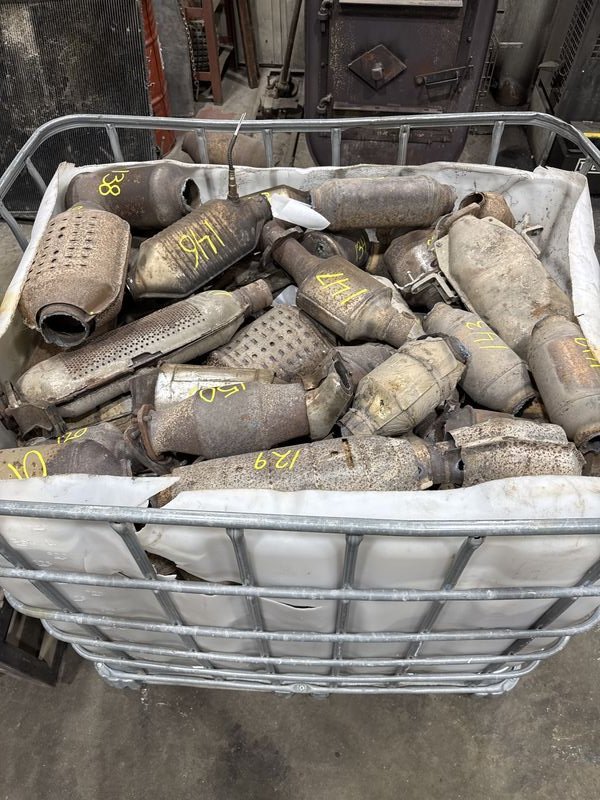
Catalytic converters are small. They don't look like much. But the metals packed inside them — platinum, palladium, rhodium — are worth more per ounce than gold. If you're sitting on a pile of cats and watching the aluminum scrap price today while wondering whether converters play by the same rules, they don't. Not even close. This is a different market with different drivers, and understanding it puts more money in your pocket.
This article breaks down exactly how catalytic converter recycling works, why prices swing so hard, and how sellers in Gary and across Indiana can stop leaving money on the table.
What's Actually Inside a Catalytic Converter
The value isn't in the steel shell. It's in the ceramic or metallic substrate inside — a honeycomb structure coated with platinum group metals (PGMs). Those three metals — platinum, palladium, and rhodium — are what recyclers are actually buying when they pay for your cats.
Different converters carry different PGM loads. A domestic passenger car cat looks nothing like a diesel truck cat or a heavy equipment unit. The ceramic substrate in a standard cat might contain fractions of a gram of each PGM, but when you multiply that across hundreds of units, the numbers get serious fast. High-value units — large diesel cats, some foreign-vehicle converters — can carry significantly more. That's why experienced recyclers sort carefully before they sell.
- Platinum: Used in diesel converters. Pricing tracks the platinum spot market.
- Palladium: Heavy in gasoline engine converters. Extremely price-volatile.
- Rhodium: The rarest of the three. Price swings have been dramatic over the past decade.
- Ceramic substrate: The carrier for the PGMs — has value as a secondary material.
- Steel shell: Scrap steel value, typically small relative to the PGM content.
The mix of these metals in any given converter determines its actual recovery value. No two converter types pay the same. That's why a buyer quoting you a flat price per unit — without sorting or assay — should raise a flag.
How the Catalytic Converter Recycling Process Works
Once a converter leaves your yard, it enters a processing chain that most sellers never see. Understanding that chain explains why prices vary so much depending on who you sell to.
First, converters are sorted by type. Experienced processors use serial numbers, visual identification, and databases to categorize units before any processing begins. After sorting, the substrate is removed from the shell. The substrate gets crushed and milled into a fine powder — called "spent catalyst" or "cat fines." That powder is then sent to a smelter, where the PGMs are chemically separated and refined into pure metal. After smelting and refining, a final assay confirms the exact metal recovery. Settlement with the seller happens after that assay, not before.
That process takes time — often weeks. The gap between when you hand over your converters and when you get final payment reflects real logistics, not a runaround. Buyers who pay immediately are pricing in that uncertainty by paying you less. You're trading price for speed. Sometimes that's the right call. Sometimes it costs you significantly.
The Role of Assay in Final Pricing
Assay is where the actual money gets determined. The smelter tests the powder sample and reports back exact PGM content in grams per metric ton. That number drives the settlement calculation. Some sellers negotiate what percentage of the recovered value they receive — called the "payable percentage." Others take a per-unit price quoted upfront. Both structures exist in the market. Knowing which one you're working under matters.
Why Catalytic Converter Prices Vary So Much — and Why It's Not Like Aluminum
If you track the aluminum scrap price today on a regular basis, you know it moves — but it moves within a range. Aluminum recycling value per pound has its own drivers: LME spot prices, tariffs, domestic demand from auto and packaging manufacturers. It's volatile, but it's a commodity market with transparent benchmarks you can track daily.
Catalytic converter pricing doesn't work like that. PGM prices trade on a separate market. Rhodium, in particular, has moved from a few hundred dollars per troy ounce to over twenty thousand dollars and back within a few years. Palladium has had similar swings. That means the cat you bought for your inventory six months ago might be worth significantly more — or less — than it would have been at purchase. Timing matters enormously.
Beyond commodity price swings, converter prices also vary because of:
- Converter type and origin: Foreign luxury vehicles often yield higher PGM content than domestic economy cars.
- Converter condition: Cracked substrates, missing ceramic, or damage reduces recovery and therefore price.
- Buyer margins: Some buyers build significant margin into upfront quotes. More competition between buyers narrows that margin.
- Volume: Large lots often command better terms than single units.
- Market timing: Selling into a rising palladium market vs. a falling one changes your outcome.
This is why comparison matters. A single buyer quoting you a number isn't giving you a market price — they're giving you their price. Those are different things.
How Sellers in Gary and Indiana Can Get Better Prices for Cats
Gary sits in the center of one of the most active industrial corridors in the Midwest. Steel yards, auto recyclers, and scrap processors operate throughout northwest Indiana. That density creates opportunity — but it also creates a market where buyers know that most sellers will take the first offer they get. Don't be that seller.
The fundamental principle is the same whether you're selling cats, copper, or trying to understand the best scrap metal prices in Gary for aluminum and non-ferrous loads: more buyers competing for your material means better price discovery. One buyer with one number is a take-it-or-leave-it situation. Multiple buyers competing changes the dynamic entirely.
Here's what better sellers do differently:
- Sort before you sell. Mixed loads get priced at the lowest common denominator. Sorted loads get priced on their actual value.
- Document everything. Photos, unit counts, serial numbers where applicable. Buyers pay more when they have confidence in what they're buying.
- Know what you have. Use available databases or buyer relationships to understand whether your inventory skews high-value or average.
- Compare offers. At minimum, get quotes from two or three buyers before you commit. Platforms built for competitive auctions make this easier — smashscrap.com is built exactly for this, connecting sellers with vetted buyers who compete for your load.
- Understand payment structure. Upfront per-unit pricing versus assay-based settlement are different products. Know what you're agreeing to.
Sellers across Indiana who treat their cat inventory like a commodity — first offer, done — consistently leave money behind. The ones who approach it like a transaction that deserves preparation and competition come out ahead. To find the best scrap metal prices today, you need to be willing to put your load in front of more than one buyer.
Aluminum vs. Catalytic Converters: Managing a Mixed Scrap Operation
Most yards handling cats are also moving aluminum, copper, steel, and non-ferrous loads on a regular basis. The pricing logic is different across these categories, but the underlying principle is the same: you need market visibility to know whether what you're being offered is competitive.
The aluminum scrap price today is something you can benchmark quickly — LME aluminum trades publicly, and domestic scrap aluminum prices correlate closely with the exchange price adjusted for local spreads. If you want to understand aluminum recycling value per pound in your region, compare what you're getting to the LME benchmark. If your buyer's number is significantly below that, competition is warranted.
For cats, there's no single public benchmark the way there is for aluminum. That's exactly why competition matters more, not less. Platforms like SMASH are built for this — auction-style selling where vetted buyers bid on your inventory. The format creates transparency in a market that often operates in the dark. Whether you're selling cats or non-ferrous loads, you can check current scrap metal prices and understand what the market is actually offering before you commit.
If you're running a mixed operation in Gary or anywhere across Indiana, building a discipline around both cat sales and commodity scrap pricing gives you a clearer picture of your operation's true margin. Don't optimize one and ignore the other.
How to Sell Catalytic Converters Online and What to Watch For
The ability to sell catalytic converters online has changed the market meaningfully over the past few years. Sellers who used to be limited to whoever drove a truck to their yard now have access to buyers across the country. That's a genuine advantage — but it comes with risk if you're not careful.
What to look for in a legitimate online buyer or platform:
- Buyer vetting: Are the buyers on the platform verified? Anonymous or unverified buyers create settlement risk.
- Documentation requirements: Legitimate buyers want photos, counts, and proper paperwork. If a buyer is indifferent to documentation, that's a red flag — not a convenience.
- Clear payment terms: Upfront vs. assay-based, timeline for settlement, what happens if there's a dispute on yield.
- No subscription fees: Platforms that only make money when you make money are aligned with your interests.
- Compliance awareness: Catalytic converter sales are subject to increasing regulatory scrutiny in many states. A good platform keeps you on the right side of documentation requirements.
Selling online doesn't mean selling blind. The best platforms create competition for your inventory while keeping the transaction documented and defensible. That's the standard you should hold any online buyer to. To read scrap metal pricing guides and stay current on market conditions, make it a regular habit — the market doesn't wait for you to catch up.
Whether you're running a full-service recycling yard in Gary or managing a smaller non-ferrous operation anywhere in Indiana, the path to better returns on catalytic converters is the same as it is for any scrap load: preparation, documentation, and competition. When you're ready to stop guessing at your market and start selling into it, check rates at best-scrap-metal-prices.com and put your inventory in front of buyers who actually compete for it.
Disclaimer: Scrap metal prices — including PGM values driving catalytic converter pricing — fluctuate daily based on commodity markets, regional supply and demand, and buyer conditions. Always verify current rates before committing to a sale.
Frequently Asked Questions
Q: Why does the aluminum scrap price today matter if I'm selling catalytic converters?
If you're running a mixed scrap operation, aluminum and catalytic converters are often sold through the same channels — but they price completely differently. Aluminum tracks the LME benchmark and gives you a clear daily reference point. Catalytic converters track PGM spot prices, which can be far more volatile. Knowing both keeps you from accepting one good price while unknowingly underselling the other.
Q: What affects catalytic converter prices the most?
The PGM content in each unit is the primary driver — platinum, palladium, and rhodium spot prices on commodity markets. Beyond that, converter type and condition, lot volume, buyer margins, and market timing all affect your final settlement number. Selling into a competitive environment rather than taking the first quote you receive addresses the buyer margin variable directly.
Q: How do I find the best scrap metal prices in Gary, Indiana for catalytic converters?
Start by knowing what you have — sorted, documented inventory gets priced more accurately than mixed, undocumented loads. Then get multiple offers. Buyers in Gary and across northwest Indiana vary in the premiums they pay. Platforms that create competitive auctions among vetted buyers, like SMASH, are built specifically for this problem. More buyer competition equals better price discovery.
Q: Is it safe to sell catalytic converters online?
Yes, if you use a platform with vetted buyers and clear documentation requirements. Catalytic converter sales face increasing regulatory scrutiny in many states, so proper paperwork is both a legal requirement and a protection for your business. Avoid any buyer who discourages documentation — that's a compliance risk, not a convenience.
Q: What's the difference between an upfront per-unit price and assay-based settlement for cats?
An upfront per-unit price gives you certainty immediately — the buyer is pricing in their processing risk and building margin to cover it. Assay-based settlement pays you after the actual PGM recovery is confirmed at the smelter, typically at a higher payable percentage of the recovered value. Upfront pricing trades potential upside for certainty. Assay settlement takes more time but can yield better returns on high-value loads.
Follow SMASH on LinkedIn for industry updates, market insights, and what's moving in the scrap metal market across North America.