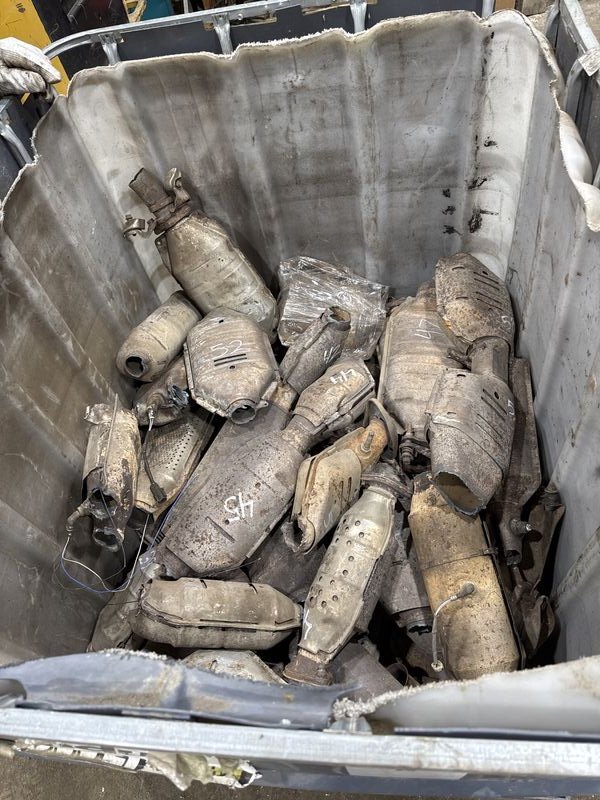
Your catalytic converter could be worth more than you think — or a lot less than the guy at the yard told you. Prices swing wildly depending on what's inside, who's buying, and how the platinum group metals market moved last week. If you're trying to figure out what your cats are actually worth in Boston or anywhere else in Massachusetts, you need to understand how this recycling chain actually works.
This isn't generic scrap metal content. Catalytic converter recycling is its own world — with its own pricing logic, its own middlemen, and its own risks. Let's break it down so you stop leaving money on the table.
And while you're researching, take a minute to find the best scrap metal prices today before you commit to any buyer.
What's Actually Inside a Catalytic Converter (And Why It Matters for Price)
Most scrap sellers think of catalytic converters as just another piece of exhaust hardware. They're not. Inside that ceramic or metallic substrate sits a precise mixture of platinum, palladium, and rhodium — collectively called platinum group metals, or PGMs. These are among the most valuable industrial metals on the planet. That's what drives the price, not the steel shell around it.
The concentration of PGMs varies dramatically depending on the vehicle make, model, engine type, and even the year it was manufactured. A converter off a late-model domestic truck isn't worth the same as one pulled from a foreign luxury sedan. Not even close. Some converters contain trace amounts of PGMs. Others are loaded. The only way to know for certain is assay testing — and most scrap yards aren't doing that on-site.
Here's what affects PGM content in a single unit:
- Vehicle origin: Foreign vehicles (Japanese, European) typically run higher PGM loads than domestic equivalents
- Engine size: Larger engines often require more catalyst material to meet emissions standards
- Emissions era: Stricter emissions regulations pushed manufacturers to use more PGMs in converters produced after tighter standards took effect
- Converter condition: Damaged, cracked, or gutted substrates lose value fast — buyers can tell
- OEM vs. aftermarket: Original equipment converters carry more PGM content than cheap aftermarket replacements
If you're pulling cats from vehicles and you don't know the difference between a high-grade and a low-grade unit, you're guessing at your own inventory. That's a problem the SMASH scrap metal auction marketplace is designed to solve — serial tracking and photo documentation mean buyers bid on what they can actually see and verify.
How Catalytic Converter Recycling Actually Works: From Your Yard to the Refinery
Most scrap sellers picture a simple transaction: pull the cat, bring it in, get paid. The real chain is longer than that — and every step between you and the refinery takes a cut. Understanding this chain tells you where your money is going and where you have leverage.
Step 1 — Collection. You pull converters from end-of-life vehicles, shop sweeps, or direct buys. This is where documentation matters. A VIN lookup ties a converter to a specific vehicle, which gives downstream buyers confidence in what they're getting. Undocumented cats raise red flags — and that affects what buyers will pay.
Step 2 — Initial sorting and pricing. A local buyer or broker looks at your load, identifies unit types, and offers a price based on their own database and current PGM spot prices. This is where most sellers get underpaid — not because of fraud, but because the buyer has better information than you do.
Step 3 — Decanning or processing. The steel shell gets separated from the ceramic substrate. The substrate gets collected into lots and shipped to a processor or directly to a smelter.
Step 4 — Assay and refining. The substrate material gets sampled and assayed to determine actual PGM content. Then it's smelted. The refined metals get sold into the industrial market — automakers, electronics manufacturers, chemical companies.
The gap between what you're paid at Step 2 and what the material actually yields at Step 4 is where margin lives for middlemen. Your job as a seller is to close that gap as much as possible. Competition among buyers — the kind you get from an auction format — helps do exactly that.
Why Catalytic Converter Prices Are So Unpredictable (Even Week to Week)
The copper scrap price today and the price next Thursday aren't the same. Same goes for cats — but with even more volatility. Here's why converter prices move around so much, even when nothing seems to have changed in your yard.
PGM spot prices shift constantly. Platinum, palladium, and rhodium trade on global commodity markets. Rhodium in particular has a history of extreme price swings — it can move hundreds of dollars per troy ounce in a short period. A converter that was worth $180 six months ago might be worth $110 today if rhodium has pulled back. Or it could be worth more. The point is, yesterday's number isn't today's number.
Supply dynamics matter. Most of the world's platinum and palladium comes from South Africa and Russia. Political instability, labor disputes, and export restrictions in those countries can move PGM prices sharply. Those moves hit your converter prices within days.
Automotive market shifts change demand. As the auto industry continues its shift toward electric vehicles, the long-term demand picture for catalytic converters changes. That affects how aggressively buyers accumulate inventory. In 2026, the EV transition is well underway — but combustion engines aren't gone, and the secondary market for cats remains active.
Buyer appetite varies by region. In a market like Boston, you've got a dense urban core with active recycling operations alongside suburban and industrial yards across Massachusetts. Buyer competition isn't equal everywhere. A yard in one part of the state may have more or fewer active buyers than a yard in a rural area — and that affects what you're actually offered on any given day.
If you want to check current scrap metal prices before your next sale, do it. The five minutes you spend on market research is worth real money on a load of converters.
How Boston Scrap Sellers Can Get More for Their Catalytic Converters
The Boston market is active. Massachusetts has a solid base of recycling yards, and the density of the region means there's real competition among buyers — if you know how to access it. Most sellers don't. They call one yard, get one number, and accept it. That's the old way.
Here's a smarter approach for sellers handling cats in the Boston area:
- Document everything before you sell. Photo documentation, serial numbers, VIN-linked inventory — these aren't just for compliance. They're leverage. Buyers bid more confidently on documented loads. That confidence shows up in the offer.
- Know your unit types. Don't walk in with a mixed load and let the buyer sort it out. Learn to identify high-grade foreign cats, domestic foil units, and aftermarket replacements. Each category has a different value. Mixing them together means the buyer prices to the lowest common denominator.
- Get multiple offers. This sounds obvious. Most sellers don't do it. Getting three offers instead of one gives you real market data — not one buyer's margin play.
- Use auction-based platforms for larger loads. If you're moving volume, a competitive auction format creates actual price discovery. More buyers, more bids, better outcome. Platforms like SMASH bring vetted buyers to compete on your inventory directly.
- Time your sales strategically. If PGM prices are trending up and you have storage capacity, holding a load for a week or two can make sense. If prices are softening, don't wait. Watch the market.
For sellers managing Boston scrap metal services, the advantage is access — this is a market with enough buyer activity that you shouldn't be settling for a single quote on a valuable load of converters.
What Role Platforms Like SMASH Play in Converter Pricing Transparency
The catalytic converter market has historically been opaque. Pricing databases exist, but they're proprietary. Buyers know more than sellers. That information asymmetry costs sellers money — not because of bad actors, but because of how markets work when one side has more data.
Auction-based platforms change the dynamic. When multiple vetted buyers compete on a documented load, the price reflects actual market demand rather than a single buyer's margin target. That's price discovery — and it's how every other commodity market works. Scrap shouldn't be different.
SMASH brings that model to the scrap yard. Inventory tools let you document loads with photos and serial tracking before they go to market. Buyers see what they're bidding on. Competition happens in the open. Auto-invoicing handles the paperwork. And there are no subscription fees — the platform only earns when you do.
For yards in Boston and across Massachusetts handling cats alongside other non-ferrous material — copper, aluminum, cores — having all of it in one documented system with competitive buying is a significant operational upgrade from the phone-call-and-guess model.
Want to understand how the full non-ferrous side of your yard fits together? Read scrap metal pricing guides that break down copper, aluminum, and specialty metals alongside converter markets.
Staying Ahead of the Market in 2026
The scrap market in 2026 rewards sellers who treat their inventory like a business asset — not a pile waiting to be hauled away. Catalytic converters are one of the highest-value items in most yards on a per-unit basis. They deserve the same attention you'd give a big copper load or a drum of non-ferrous cores.
Track the PGM market. Know your unit grades. Document before you sell. Get more than one offer. And use platforms that give buyers a reason to compete for your material rather than just waiting for you to accept whatever number they give you on the phone.
The old way of selling cats — one call, one number, no documentation — leaves real money behind. The market has moved. Your approach should too.
Get the best scrap metal prices for your catalytic converters and non-ferrous loads — check rates at best-scrap-metal-prices.com and stop guessing what your material is actually worth.
Disclaimer: Catalytic converter prices and PGM spot values fluctuate daily based on global commodity markets. Always verify current rates before selling. The figures and ranges referenced in this article are for educational context only and do not represent guaranteed purchase prices.
Frequently Asked Questions
Q: How does the copper scrap price today affect catalytic converter values?
Copper scrap prices and catalytic converter prices are driven by different metals — copper by copper spot, cats by PGM spot prices like platinum, palladium, and rhodium. However, both move with broader commodity market sentiment. When industrial metals are generally rising, both tend to benefit. Tracking the copper scrap price today gives you a useful read on overall market direction, even if it doesn't directly set your converter price.
Q: Where can I get the best catalytic converter scrap prices in Boston?
Getting the best price in Boston means getting more than one offer and knowing what grade your units are before you walk into a yard. Massachusetts has enough active buyers that you should never settle for a single quote on a valuable load. Documented inventory — with photos and serial tracking — consistently draws stronger bids than undocumented material.
Q: Why do two catalytic converters that look the same sell for different prices?
Because what's inside is what matters, not the exterior. PGM content varies by vehicle make, model, engine size, and manufacturer era. A converter from a late-model foreign vehicle can be worth several times more than a superficially similar unit from a domestic compact. The only way to know is to identify the unit type — either by vehicle VIN, serial number, or recognizing the unit visually from a pricing database.
Q: Is it worth selling catalytic converters separately from my other scrap?
Almost always yes, especially on higher-grade units. Mixing converters into a general scrap load means the buyer prices the whole thing to the lowest value item. Separating your cats, grading them, and selling them as a documented specialty load gives buyers a clear picture — and gives you more room to negotiate or attract competitive bids.
Q: How do I know if a scrap buyer is offering a fair price for my catalytic converters?
Cross-reference against current PGM spot prices and get at least two or three offers from different buyers. If one number is significantly lower than the others with no explanation, that's your answer. Auction-based platforms like SMASH create competitive pricing by default — multiple vetted buyers see the same documented load and bid against each other, which is a reliable way to find where the actual market sits on a given day.
Follow SMASH on LinkedIn for scrap metal market insights, industry updates, and auction news: linkedin.com/company/scrap-metal-auction-sales-hub.
```